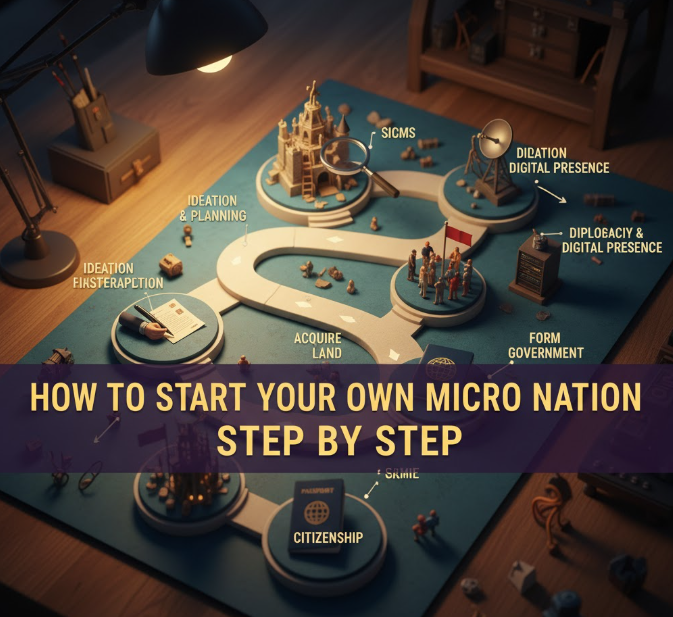


Have you ever dreamed of creating your own country? 🌍 Maybe a small island where your rules apply, your flag waves proudly, and your people share a vision of freedom and creativity.
That dream is known as a micronation — a self-declared independent entity that claims to be a nation but isn’t recognized by major governments or international organizations.
While the idea sounds exciting (and honestly, it is!), most micronations don’t last very long. They start with great energy but soon fade away.
Let’s explore why this happens and, more importantly, how to avoid those mistakes if you ever want to build one yourself.
The Meaning Behind a Micronation
A micronation is usually created by individuals or small groups who want to establish their own system of governance, culture, or ideology.
Some are serious experiments in politics or society, while others are creative art projects or just fun communities online.
Examples include the Principality of Sealand, built on a sea fort off the coast of England, or the Republic of Molossia in Nevada, USA.
Both are iconic — yet for every Sealand, there are hundreds of micronations that collapse within months. 😞
Why Most Micro Nations Fail
So, what goes wrong? Let’s look at the main reasons in a simple, no-fluff way.
1. Lack of Realistic Planning
Many founders jump in with excitement but without a real plan.
They create a flag, a name, maybe even a national anthem — but they forget the hard part: governance, funding, and sustainability.
Building even a small nation requires a framework. Who makes the laws? How will disputes be solved?
What happens if members disagree? Without clear answers, chaos follows fast.
Example:
| Problem | Effect |
|---|---|
| No rules or structure | Members lose trust |
| Undefined leadership roles | Internal conflict |
| No future goals | The project dies early |
To avoid this, start small. Write a basic constitution, even if it’s just a few pages.
Set short-term goals like forming a council, creating a community website, or defining member rights.
2. Overreliance on One Person
Many micronations are built around one person’s vision — usually the founder. 👑
While passion is good, too much dependence on one person can destroy the project.
If that leader loses interest or disappears, everything falls apart.
It’s similar to how a company with no backup leadership collapses when the CEO leaves.
How to fix it:
-
Share responsibilities with a team.
-
Train others in communication, management, and diplomacy.
-
Let members feel ownership — not just obedience.
A successful micronation is a community, not a one-person show.
3. Lack of Financial Stability
Money. The word nobody likes but everybody needs. 💰
Without funds, it’s almost impossible to keep a micronation running — even if it’s online.
You need money for:
-
Hosting a website
-
Designing flags, coins, or IDs
-
Organizing events or gatherings
-
Marketing your presence online
Many micronations collapse because the founder spends their own money and burns out.
If there’s no plan for sustainable income (like memberships, donations, or digital products), the project simply can’t survive.
Pro Tip:
Build an economic model — even a symbolic one. For example:
| Income Source | Description |
|---|---|
| Membership fees | Small annual contributions from citizens |
| Merchandise | Selling flags, coins, or T-shirts |
| Online services | Virtual passports, collectibles, or events |
It’s not about getting rich — it’s about staying alive.
4. Unrealistic Claims of Sovereignty
Here’s the truth: most governments don’t take micronations seriously.
Declaring independence from your backyard doesn’t make you legally recognized.
Many founders send letters to the UN or nearby states demanding acknowledgment. When that fails, they lose motivation.
Recognition, however, should not be the main goal at the start. Focus on building community, not chasing legitimacy.
Reality check:
| Stage | Focus |
|---|---|
| Early stage | Build structure & identity |
| Mid stage | Grow population & economy |
| Later stage | Seek awareness or symbolic diplomacy |
Don’t expect immediate recognition — it almost never happens.
Instead, aim to be respected and organized within the micronation community first.
5. Poor Communication and Internal Conflict
Disagreements are normal, but when they explode, they destroy everything. ⚔️
Many micronations break apart because of power struggles, ego clashes, or miscommunication.
If people don’t feel heard, they’ll leave — and in small communities, even one person leaving can be a big loss.
Tips to handle conflict:
-
Create clear communication rules.
-
Have a small council or court to handle disputes.
-
Use transparent voting or discussion systems.
Think of your micronation like a family — everyone must feel valued and respected.
6. Ignoring Legal Boundaries
This one’s serious. 🚨
Some micronation founders accidentally break real-world laws. For example, creating fake passports or currency that resemble official ones can attract legal trouble.
Others try to occupy land or declare independence on private property, which can lead to arrests or fines.
Always study the laws of your country before starting any activity.
Micronations are fun and creative, but they must stay within legal limits.

7. No Clear Purpose or Vision
What does your micronation stand for? Freedom? Art? Environmentalism?
Without a clear purpose, it’s just a hobby — not a movement.
A powerful micronation usually stands on a strong idea.
Think about what problem your nation wants to highlight or solve.
Examples:
-
Environmental awareness 🌿
-
Digital citizenship 🌐
-
Peace and creativity 🎨
If people believe in your vision, they’ll join and stay.
8. Neglecting the Power of Online Presence
We live in a digital age.
Many successful micronations survive because they’re active online — through websites, social media, and newsletters.
Having a digital presence gives legitimacy and attracts citizens from around the world.
Without it, your micronation becomes invisible.
To grow your online identity:
-
Build a simple website.
-
Post regular updates about your culture, news, and projects.
-
Engage with other micronations — join forums and summits.
Remember, visibility = survival.
9. Poor Leadership and Ego Problems
Some micronations collapse simply because the leaders act like dictators. 👑
They enjoy the title “King” or “President” but forget the real responsibility — serving their citizens.
Leadership is not about control; it’s about guidance and cooperation.
If leaders act selfishly, the community will quickly crumble.
Good leaders:
-
Listen before they decide
-
Stay humble and fair
-
Admit mistakes
-
Motivate people with respect
Great leadership builds trust — and trust keeps your nation alive.
10. Not Adapting to Change
Every society evolves. The same should happen with micronations.
If you don’t adapt, your project will fade.
New ideas, technologies, or world trends can shape your micronation’s direction.
For example, if your nation started with physical gatherings but now most members are online, update your system.
Adaptation shows maturity — and maturity earns respect.
How to Make Your Micronation Last
So now that we know the problems, let’s flip the table and see the solutions.
| Key Factor | Description |
|---|---|
| Clear Vision | Define your nation’s values and long-term goals. |
| Strong Community | Encourage teamwork and citizen participation. |
| Sustainable Funding | Create fair, creative income sources. |
| Legal Awareness | Stay within local and international laws. |
| Digital Growth | Maintain active online communication. |
| Adaptability | Be flexible to changes in trends or technology. |
Building a micronation isn’t about running away from reality — it’s about creating a small piece of it that reflects your dreams. 🌏
If you approach it with patience, respect, and planning, it can become something truly inspiring.
Real-World Examples That Teach Valuable Lessons
| Micronation | Lesson Learned |
|---|---|
| Sealand | Longevity through simplicity — it stayed focused on survival, not recognition. |
| Molossia | Humor and openness attract people. It didn’t take itself too seriously. |
| Hutt River Province (Australia) | Even with decades of success, ignoring national tax laws can cause downfall. |
| Republic of Minerva | Without proper defense or recognition, external forces can easily end a micronation. |
Learning from others helps avoid repeating mistakes.
Final Thoughts
Micronations fail not because the idea is bad — but because they forget the balance between dream and discipline.
A micronation is like a living organism. It needs:
-
A heart (vision) ❤️
-
A brain (planning) 🧠
-
And hands (community) 🙌
If one fails, the body collapses. But if all work together, your micronation can live for decades — maybe even forever.
Frequently Asked Questions (FAQs)
Q1: Can anyone start a micronation?
Yes! Anyone can declare a micronation. But to make it meaningful, you should plan its structure, goals, and legal boundaries carefully.
Q2: Can a micronation get recognized by the UN?
In theory, yes — but in practice, it’s nearly impossible. Recognition requires international diplomacy, territory, and population.
Q3: Do I need land to start a micronation?
Not necessarily. Many modern micronations exist online as digital nations. You can start with a virtual community first.
Q4: How do I get people to join my micronation?
Start by promoting your vision on social media, forums, and interest groups. Offer value — a sense of belonging, creativity, or fun.
Q5: What’s the biggest secret to surviving as a micronation?
Consistency. Even if you grow slowly, stay active and keep improving.
A small, stable nation is better than a big, chaotic one.
In the End…
Creating a micronation is a beautiful act of imagination — a mix of art, politics, and passion. 🌟
But only those who mix dreams with strategy truly last.
So if you ever plan to start your own little country, remember:
Don’t just build a flag — build a foundation. 🏗️