

In today’s world, hundreds of tiny nations — often called micronations — exist as independent or self-declared states. Some are made for fun, others for political reasons, and a few even for cultural or environmental purposes. But have you ever thought about where these micronations get their inspiration from? Interestingly, many of their ideas trace back to the great ancient civilizations that shaped human history. 🌍
Let’s explore how ancient civilizations have influenced modern micronations — their structure, beliefs, laws, and even the idea of sovereignty itself.
The Root of Civilization: Lessons in Order and Identity
Ancient civilizations like Mesopotamia, Egypt, Greece, and Rome were the first to create systems — systems of governance, laws, social classes, and trade. They gave meaning to the idea of being “a nation.”
For example, Mesopotamia (often called the “Cradle of Civilization”) introduced organized city-states such as Ur and Babylon. These small independent regions operated like modern micronations: limited in size but rich in identity. They had their own kings, currencies, and laws.
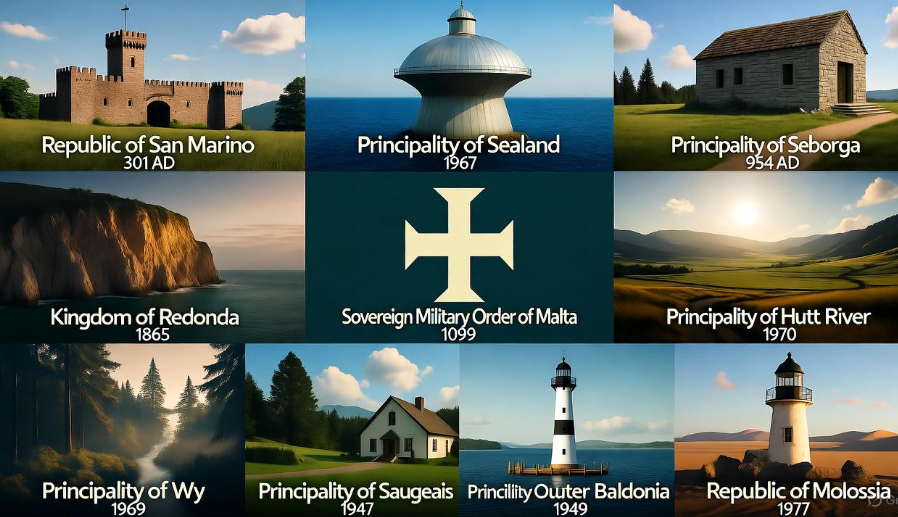
Today, micronations like Sealand or Molossia follow a similar pattern — creating a defined territory, a ruler, a constitution, and even passports. The lesson is clear: size doesn’t define sovereignty — structure does.
| Ancient Civilization | Key Idea | Modern Micronation Example | Shared Concept |
|---|---|---|---|
| Mesopotamia | City-state independence | Principality of Sealand | Self-governance |
| Ancient Greece | Citizenship & democracy | Republic of Molossia | Civic identity |
| Ancient Egypt | Divine leadership | Aerican Empire | Symbolic monarchy |
| Roman Empire | Law & order | Liberland | Legal framework |
| Mayan Civilization | Cultural preservation | Atlantium | Heritage focus |
The Power of Identity and Symbolism
Ancient civilizations understood one thing very well: symbols unite people.
The Egyptian pharaohs used pyramids, the Greeks used the owl of Athena, and the Romans had their eagles — each a sign of power and belonging. Micronations borrow this concept heavily. Flags, anthems, and coats of arms are not random decorations; they are symbols that give people a feeling of shared identity.
For instance, the Empire of Atlantium uses ancient Roman-style imagery to appear grand, even though it’s just a small online-based micronation. These visual cues build authority, much like the crowns and seals of kings thousands of years ago.
Democracy and Governance – The Greek Gift 🏛️
The ancient Greeks were the pioneers of democracy. They believed citizens should have a voice in how they’re governed.
Modern micronations such as the Republic of Molossia adopt democratic structures — with elections, constitutions, and ministries. This mirrors the Athenian model where citizens debated laws and policies.
Even though some micronations are tiny, their leaders still hold citizen meetings, online votes, and public declarations, much like the Athenian assemblies. The idea is simple: every voice matters, no matter how small the nation.
The Roman Legacy: Law and Order ⚖️
If Greece gave democracy to the world, Rome gave it laws.
Ancient Rome’s legal system — written, codified, and fair — has influenced almost every modern nation, including micronations. Romans understood that laws were not just rules, but the backbone of civilization.
Micronations like Liberland and Christiania have written constitutions and codes of conduct. They may not be recognized internationally, but internally, they function just like the Roman Republic — maintaining peace through structure and rights.
Without a written system, even a small society can fall apart. That’s something both ancient empires and tiny micronations agree upon.
The Egyptian Lesson: Vision and Legacy 🌄
Egyptians didn’t just build pyramids — they built legacies.
Their civilization taught the world about planning for the long term. They believed what they created should last forever — temples, hieroglyphs, monuments. Micronations follow the same philosophy in their own way.
They create archives, websites, national days, and cultural projects to make sure their identity doesn’t fade. For example, the Aerican Empire treats humor and imagination as its cultural foundation, ensuring that its unique identity will be remembered.
This reflects Egypt’s focus on preserving history — even if it’s carved on a digital “stone.”
Mayan Civilization: The Power of Culture and Nature 🌿
The Mayans had deep respect for nature, seasons, and balance. Their society was structured around agriculture, astronomy, and spirituality.
Some modern micronations, such as Wirtland or Ladonia, follow similar ideals. Wirtland promotes global citizenship without harming the environment, while Ladonia celebrates art and nature.
These micronations have learned from ancient civilizations that land and culture must go hand in hand. They aim to live in harmony with their surroundings — something the Mayans valued more than anything.
Chinese Civilization: Unity Through Administration
Ancient China thrived because of its efficient administrative systems. They had bureaucrats, registries, taxes, and long-term plans.
Modern micronations take notes from this model. They build ministries (even symbolic ones) for finance, foreign affairs, and culture.
For example, Sealand — though only a small platform in the sea — has official titles like “Minister of Information” and “Chief of Security.” This administrative mimicry creates legitimacy, just like the early dynasties did.
Trade and Economy: The Phoenician Secret 💰
The Phoenicians were not warriors — they were traders. They understood that commerce creates power.
Modern micronations often launch their own digital currencies, stamps, or coins. These are not just for show; they’re tools to create an internal economy.
For instance, the Republic of Molossia uses its own currency called the Valora, pegged to the value of cookie dough — a humorous yet structured economic symbol!
Just like the Phoenicians traded purple dye across the Mediterranean, micronations today use trade to stay relevant in a globalized world — even if it’s symbolic.
The Persian Empire: Tolerance and Multiculturalism 🌏
The Persian Empire, under Cyrus the Great, was one of the first to practice religious tolerance. It allowed people of different faiths and languages to live peacefully under one rule.
Micronations like Atlantium and Wirtland take a similar approach. They accept people from all over the world, regardless of nationality, race, or religion.
Their message is simple: a small state can still be inclusive. In that sense, they’re carrying forward the Persian idea that diversity strengthens society.

Spiritual Lessons: The Indian Subcontinent 🕉️
Ancient India introduced philosophies like dharma (duty), karma (action and result), and ahimsa (non-violence).
Some micronations borrow these values in modern forms. For instance, Asgardia, the “space nation,” promotes peace, science, and unity — values that echo India’s spiritual wisdom of cooperation and balance.
They prove that even a modern digital state can be inspired by ancient ideas of harmony and moral duty.
Cultural Continuity: The Indigenous Teachings
Indigenous civilizations — like the Aboriginals of Australia or the Native Americans — valued community, respect, and storytelling.
Micronations that emphasize creativity and shared culture, such as Freetown Christiania in Denmark, mirror these values. They believe that a nation doesn’t need borders — it needs belonging.
Their communities thrive on trust and shared purpose rather than rigid control. That’s a very ancient lesson indeed.
What Ancient Civilizations and Micronations Have in Common
Let’s simplify the core similarities in a quick table 👇
| Ancient Civilization Value | Micronation Practice | Common Message |
|---|---|---|
| Governance & Laws (Rome) | Written Constitutions | Order ensures survival |
| Civic Participation (Greece) | Citizen Voting | Everyone’s voice counts |
| Cultural Heritage (Maya) | Art & History Projects | Identity keeps nations alive |
| Economic Systems (Phoenicia) | Custom Currency | Trade defines independence |
| Tolerance (Persia) | Open Citizenship | Diversity is strength |
| Long-Term Vision (Egypt) | Archives & Traditions | Legacy matters |
Why These Lessons Still Matter Today
Micronations may be small, but they represent big ideas. Their existence challenges how we define a country, a community, or even citizenship. Ancient civilizations remind us that nations aren’t made from size or recognition — they’re made from vision, unity, and purpose.
From the pyramids to pixelated passports, humanity’s urge to organize, belong, and create identity has never disappeared. It simply evolved.
Micronations are living examples of how ancient wisdom still guides us in the digital age.
FAQs
Q1: What is a micronation?
A micronation is a self-declared independent state that is not officially recognized by world governments. They often have their own laws, flags, and currencies.
Q2: How are micronations related to ancient civilizations?
Micronations borrow ideas from ancient civilizations — like structure, law, symbolism, and governance — to establish their identity and legitimacy.
Q3: Are micronations legal?
While most are not recognized as sovereign countries, many operate peacefully under existing national laws as hobbyist or cultural communities.
Q4: What’s the most famous micronation?
The Principality of Sealand, located on an old sea fort off the coast of England, is one of the best-known and longest-standing micronations.
Q5: Can anyone start a micronation?
Yes, anyone can create one — but maintaining it requires structure, community, and purpose, just like ancient civilizations did.
Final Thoughts 🌎
Ancient civilizations may have vanished, but their spirit still lives in surprising ways — even in the smallest corners of modern life.
Micronations, though tiny, remind us of humanity’s timeless desire to build, organize, and express identity. Whether through the structured laws of Rome, the democracy of Greece, or the creativity of Egypt, these ancient lessons continue to shape our modern experiments in nationhood.
In the end, both ancient empires and modern micronations teach one powerful truth: it’s not about how large a nation is, but how deeply it believes in its purpose.