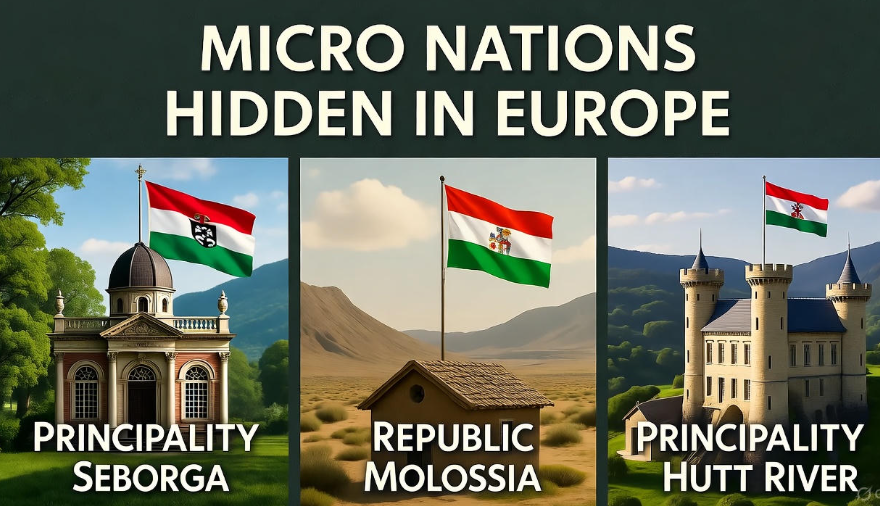

Europe is full of surprises. Behind its famous countries like France, Italy, and Germany, there are small, lesser-known “micro nations.” These are tiny, self-declared states that often exist inside or beside big countries. Some are serious about independence, while others started as social experiments or even jokes that turned into real communities. Yet, they all share something special — a story of people who wanted to live by their own rules.
So, let’s take a walk through these hidden corners of Europe, where creativity, rebellion, and freedom have built small worlds of their own.
What are Micro Nations? 🤔
A micro nation is not just a small country. It’s usually an area that declares itself independent but isn’t officially recognized by the world. Many were born out of protest, humor, or personal dreams. Some have their own flags, currencies, stamps, and passports.
Here’s a quick table to understand how they differ from normal countries:
| Feature | Micro Nation | Recognized Nation |
|---|---|---|
| International Recognition | ❌ Usually not recognized | ✅ Recognized by UN |
| Population | Often under 100 | Millions |
| Area | A few square meters to a few km² | Hundreds of thousands of km² |
| Government | Self-made system | Elected or royal system |
| Purpose | Personal, cultural, or political | National identity and governance |
Now that you have a picture of what they are, let’s dive into some of the most interesting micro nations hidden in Europe.
Sealand (United Kingdom) 🏰
Imagine a nation built on an old sea fort! The Principality of Sealand, located off the coast of England, began in 1967 when Paddy Roy Bates took over an abandoned military platform in the North Sea.
He declared it an independent nation, with his family as royalty. Sealand even has its own flag, constitution, and national motto — E Mare Libertas (“From the sea, freedom”).
Despite its tiny size (only about 550 square meters), Sealand has survived attacks, fire, and legal battles. It’s now a symbol of independence and resilience. Some call it “the world’s smallest country.”
The Republic of Molossia (Europe-Inspired Spirit) 🇪🇺🇲🇫
Though the Republic of Molossia is in the U.S., it’s heavily inspired by European micro nations and uses European-style government and currency. Founded by Kevin Baugh, it has its own time zone and even declared war on East Germany (long after East Germany disappeared!).
Molossia’s playful spirit reflects the same charm seen in European micro nations — creativity and humor blended with real structure.
The Principality of Seborga (Italy) 🇮🇹
Hidden in northern Italy, the small town of Seborga claims to be a principality that never legally became part of Italy. Locals even elect their own “prince” and government.
Seborga issues its own currency, the Luigino, and residents proudly display the Seborgan flag on their homes. It’s more symbolic than political, but the sense of identity is real. Visitors often say Seborga feels like a “country within a country.”
Christiania (Denmark) 🇩🇰
In the heart of Copenhagen lies one of Europe’s most famous “free towns” — Freetown Christiania. Founded in 1971 by a group of hippies, it occupies old military land and functions as a self-governing community.
Christiania rejects traditional government control. People live cooperatively, make their own laws, and use alternative lifestyles. It’s famous for its colorful houses, murals, and peaceful yet rebellious vibe.
The Danish government has tried several times to regulate it, but Christiania still stands strong as a symbol of freedom and creativity.
The Republic of Užupis (Lithuania) 🇱🇹
In Vilnius, Lithuania, an artistic neighborhood declared itself the Republic of Užupis in 1997. It has its own constitution, president, and even an army (of about 12 people).
The Užupis Constitution is full of humor and philosophy. Some of its famous “laws” include:
-
Everyone has the right to be happy.
-
Everyone has the right to be unique.
-
A dog has the right to be a dog.
It’s whimsical, peaceful, and filled with art. Užupis even celebrates its Independence Day every April 1st — yes, on April Fool’s Day! 😄
The Principality of Hutt River (Inspiration for Europe’s Mini States) 🇦🇺
Although located in Australia, Hutt River inspired many European micro nations. It showed that one person’s protest could turn into a long-lasting independent identity. European micronations like Seborga and Sealand often cite Hutt River as a model of self-determination.
The Kingdom of Lovely (United Kingdom) 🇬🇧
Created by British comedian Danny Wallace in 2005, this “nation” began as a social experiment for his TV show How to Start Your Own Country.
He declared his London flat an independent country — the Kingdom of Lovely. It gained thousands of online citizens and even had an anthem and national flag.
Though it doesn’t exist physically anymore, its digital spirit lives on, reminding us that nations start with ideas, not land.
The Grand Duchy of Flandrensis (Belgium) 🇧🇪
Founded in 2008 by Niels Vermeersch, Flandrensis claims territories in Antarctica (yes, really!). It doesn’t aim to control land but rather to raise awareness about climate change.
Flandrensis describes itself as an eco-micronation — no citizens live on its claimed territory, and it promotes environmental responsibility and peaceful coexistence.
This unique purpose sets it apart. It’s not just fun or rebellious — it’s a message about global citizenship.
The Principality of New Utopia (Europe-Inspired Vision) 🌊
Though it was planned to be in the Caribbean, New Utopia had deep European roots. Its founder, Lazarus Long, envisioned a luxurious floating city-state based on European ideals of royalty and order.
It never came to life, but its design inspired European sea-based micronations like Sealand and other futuristic sovereignty projects.
The Sovereign Military Order of Malta (Malta/Rome) ⛪
Unlike other micro nations, the Order of Malta is recognized by many countries and the Vatican. It has no land of its own (except a few buildings in Rome and Malta), but it issues passports, has diplomatic relations, and operates humanitarian missions worldwide.
It’s one of the oldest “stateless nations” — tracing back to the Knights Hospitaller of the 11th century. In many ways, it’s the ancestor of modern micronations.
Why Do People Create Micro Nations? 💭
It’s easy to think of these projects as silly — but there’s real meaning behind most of them.
Here are some common reasons why people start micro nations:
| Motivation | Example |
|---|---|
| Protest against government | Sealand |
| Artistic expression | Užupis |
| Community independence | Christiania |
| Humor or creativity | Lovely |
| Environmental activism | Flandrensis |
In short, people build micro nations because they want control, freedom, or simply a fun way to express themselves.
Challenges Micro Nations Face ⚖️
Micro nations sound exciting, but they face real issues:
-
Lack of recognition — Most world governments don’t take them seriously.
-
Financial problems — Running even a small territory can be expensive.
-
Legal battles — They often clash with national laws.
-
Internal disputes — Some fail because of disagreements among founders.
-
Sustainability — Many start as projects but fade over time.
Despite this, a few have lasted decades, showing that passion and creativity can sometimes beat all odds.
Can You Visit a Micro Nation? ✈️
Yes — many welcome visitors!
Here’s a short list:
| Micro Nation | Can You Visit? | Fun Fact |
|---|---|---|
| Sealand | ❌ Not open to public | Visits by special request only |
| Seborga | ✅ Yes | Has tourist tours |
| Christiania | ✅ Yes | A popular spot in Copenhagen |
| Užupis | ✅ Yes | You can get your passport stamped! |
| Flandrensis | ❌ No land to visit | Operates online |
So next time you travel through Europe, keep your eyes open — you might step into a whole new “country” without even realizing it.
The Future of Micro Nations in Europe 🔮
Micro nations are unlikely to replace real countries, but they do challenge how we think about borders and identity. In an age of global citizenship, these small movements remind us that independence begins with imagination.
More digital nations are emerging too — communities that exist online with citizens spread across the world. Europe, with its rich culture and political diversity, will likely continue to be a breeding ground for such experiments.
Fun Facts About European Micro Nations 🎉
-
Sealand has its own royal family and titles you can buy online.
-
Užupis celebrates April 1st as its Independence Day — fittingly, April Fool’s Day.
-
Christiania has banned cars inside its borders.
-
Seborga once printed its own money called the “Luigino.”
-
The Order of Malta is older than most modern European countries.
Frequently Asked Questions (FAQs) ❓
Q1: Are micro nations legal?
They exist in a gray area. Most countries don’t officially recognize them, but they often tolerate them as long as they don’t cause trouble.
Q2: Can I start my own micro nation?
Yes, anyone can — but it won’t be legally recognized. Many start online or on private land.
Q3: Do micro nations have citizens?
Some do! For example, Flandrensis and Lovely both had thousands of registered online citizens.
Q4: Can you use their passports for travel?
No. These passports are symbolic and not accepted at real borders.
Q5: What makes European micro nations special?
Europe’s long history of kingdoms, independence movements, and art gives its micro nations a unique mix of tradition and rebellion.
Final Thoughts 🌍✨
Exploring Europe’s hidden micro nations is like opening a secret chapter of human creativity. These small worlds remind us that freedom isn’t always about size or power — sometimes, it’s just about imagination.
From the artistic streets of Užupis to the ocean fortress of Sealand, these communities prove that independence can live in the smallest of places. So next time you walk through Europe, look a little closer… you might just cross a border you didn’t even know existed. 😉