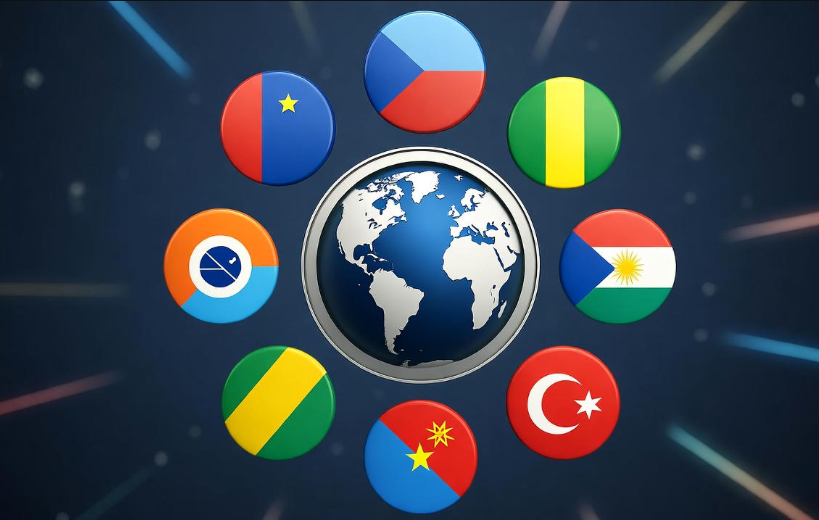

Have you ever dreamed of starting your own country? 🌱 Believe it or not, some people actually did! Across the world, there are tiny, self-declared nations — some serious, some funny, and some just… fascinating. These are called micronations — mini countries that often exist inside bigger ones, claiming independence that most of the world doesn’t officially recognize.
Let’s take a fun, honest, and eye-opening journey to explore the Top 10 Micronations Around the World — and trust me, each one has a story that’ll make you smile, think, or simply say, “Wow, people actually did that!” 😄
1. The Principality of Sealand 🏰 (North Sea)
Located on a small sea fort off the coast of England, Sealand is often called the world’s most famous micronation. It was founded in 1967 by Paddy Roy Bates, who occupied an abandoned military fort named Roughs Tower. He declared it independent and named himself “Prince Roy.”
Despite its tiny size (just 0.004 square kilometers), Sealand has its own flag, national motto, coins, passports, and even a royal family! Although the UK doesn’t officially recognize it, Sealand still stands strong today — guarded by its loyal citizens and even offering online citizenships.
| Feature | Details |
|---|---|
| Location | North Sea, 12 km off Suffolk, England |
| Founded | 1967 |
| Area | 0.004 km² |
| Founder | Paddy Roy Bates |
| Currency | Sealand Dollar |
| Motto | “E Mare Libertas” (From the Sea, Freedom) |
2. The Republic of Molossia 🇺🇸 (Nevada, USA)
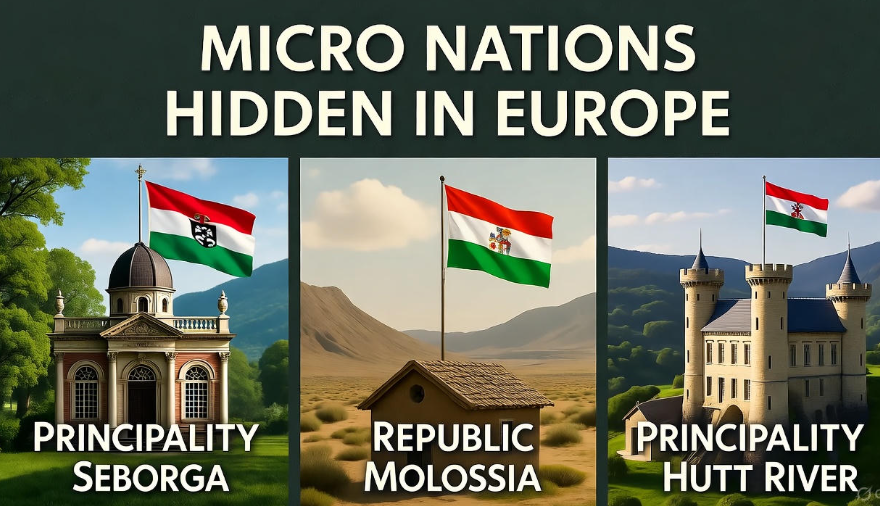
Hidden in the Nevada desert is a small nation called the Republic of Molossia. Founded by Kevin Baugh in 1999, Molossia has its own government, national anthem, currency (called the Valora), and even a space program — yes, you read that right! 🚀
Molossia might only cover a few acres, but it’s packed with humor and pride. It has strict customs rules (you can’t bring cats or plastic shopping bags inside!) and even claims to be at war with East Germany — a war that has “technically” never ended. 😅
| Feature | Details |
|---|---|
| Location | Dayton, Nevada, USA |
| Founded | 1999 |
| Area | 0.015 km² |
| Founder | Kevin Baugh |
| Currency | Valora (pegged to cookie dough!) |
| Motto | “Make the World a Better Place” |
3. The Principality of Hutt River 🇦🇺 (Australia)
Back in 1970, Leonard Casley, a farmer in Western Australia, declared his land independent from Australia after a dispute over wheat quotas. He named it the Principality of Hutt River, and himself Prince Leonard.
For decades, it operated like a real country — issuing its own stamps, currency, and passports. Thousands of tourists visited every year. Sadly, it was officially dissolved in 2020 due to tax issues. But still, its story remains legendary in the world of micronations.
| Feature | Details |
|---|---|
| Location | Western Australia |
| Founded | 1970 |
| Area | 75 km² |
| Founder | Leonard Casley |
| Status | Dissolved (2020) |
4. The Principality of Seborga 🇮🇹 (Italy)
In the hills of northern Italy, near Monaco, lies the picturesque town of Seborga. The locals believe it was once a sovereign principality before Italy was unified — and that they still deserve independence.
The people of Seborga even elect a “prince,” have a royal guard, and issue their own currency called the Luigino. It’s more of a cultural symbol than a political rebellion, but the residents take their identity seriously — and visitors love the charm of this “secret kingdom.” 👑
5. The Free Republic of Liberland 🇨🇿 (Between Croatia and Serbia)
In 2015, a Czech politician named Vít Jedlička claimed a small piece of unclaimed land on the Danube River between Croatia and Serbia. He called it Liberland, a new free country dedicated to liberty and minimal government.
Liberland quickly gained attention online and attracted thousands of “citizens” from around the world who support its idea of ultimate freedom. However, Croatia guards the area, and people can’t yet live there permanently.
| Feature | Details |
|---|---|
| Location | Between Croatia and Serbia |
| Founded | 2015 |
| Area | 7 km² |
| Founder | Vít Jedlička |
| Motto | “To Live and Let Live” |
6. The Principality of Wy 🇦🇺 (Australia)
When Paul Delprat, an artist in Sydney, lost a long battle with his local council over a driveway, he decided to do something bold — he declared his home a sovereign nation in 2004 and named it the Principality of Wy. 🎨
Wy is famous for its creative and humorous nature. It’s not politically rebellious, just a fun statement about independence and freedom of expression. The “Prince” even holds art exhibitions as part of Wy’s culture.
7. The Kingdom of Talossa 🇺🇸 (USA)
The Kingdom of Talossa began in 1979 when Robert Ben Madison, then a teenager, declared his bedroom in Milwaukee an independent country. He even created a language called Talossan!
What started as a joke turned into a global online community with hundreds of citizens worldwide. Today, Talossa has a functioning government, elections, and a quirky but loyal group of people who take their “nation” seriously — in the most fun way possible. 💻
8. The Republic of Minerva 🌊 (South Pacific Ocean)
The Republic of Minerva was one of the boldest micronation attempts. In 1972, a millionaire named Michael Oliver built artificial islands on reefs in the Pacific Ocean to create a tax-free libertarian paradise.
But the dream didn’t last long — the nearby country Tonga quickly claimed the area and took over. Still, Minerva remains an interesting symbol of how far some people will go to chase freedom.
9. The Conch Republic 🇺🇸 (Key West, Florida)
In 1982, Key West residents humorously declared independence from the United States after a border roadblock caused problems for tourism. They named themselves the Conch Republic and declared war — only to surrender one minute later and request foreign aid! 😆
Today, it’s a proud local identity. The Conch Republic has passports, flags, parades, and even an official motto: “We Seceded Where Others Failed.”
| Feature | Details |
|---|---|
| Location | Key West, Florida |
| Founded | 1982 |
| Founder | Dennis Wardlow |
| Status | Cultural movement (still alive!) |
10. The Empire of Atlantium 🌏 (Australia)
Founded in 1981 by George Cruickshank, the Empire of Atlantium is one of the most organized micronations in the world. Based in New South Wales, it promotes global citizenship, human rights, and unity beyond borders.
Atlantium has a constitution, flag, and even ministers. Unlike most micronations, it doesn’t focus on land — it’s a philosophical nation, encouraging people to think globally instead of nationally. 🌐
| Feature | Details |
|---|---|
| Location | New South Wales, Australia |
| Founded | 1981 |
| Motto | “Pro Humanitate” (For Humanity) |
| Type | Global Micro-Empire |
Quick Comparison Table 🧭
| Micronation | Country of Origin | Founded | Type | Still Active? |
|---|---|---|---|---|
| Sealand | UK | 1967 | Sea Fort | ✅ Yes |
| Molossia | USA | 1999 | Desert Nation | ✅ Yes |
| Hutt River | Australia | 1970 | Farm Kingdom | ❌ No (closed 2020) |
| Seborga | Italy | 1960s (revived) | Historic Town | ✅ Yes |
| Liberland | Croatia/Serbia | 2015 | Libertarian State | ✅ Yes |
| Wy | Australia | 2004 | Artistic Principality | ✅ Yes |
| Talossa | USA | 1979 | Online Nation | ✅ Yes |
| Minerva | Pacific Ocean | 1972 | Artificial Island | ❌ No |
| Conch Republic | USA | 1982 | Cultural Identity | ✅ Yes |
| Atlantium | Australia | 1981 | Global Empire | ✅ Yes |
Why Do People Create Micronations? 🤔
Most micronations start because people want:
-
Freedom from government control
-
Creative expression or political protest
-
Cultural preservation
-
Or sometimes, just for fun and community
Some use humor, others serious ideals. But all of them share one dream — to build a place where they belong.
Interesting Facts 💡
-
The smallest micronation (Sealand) is smaller than a tennis court!
-
Some micronations issue real passports and stamps that collectors buy online.
-
You can actually apply for citizenship in a few of them through their official websites.
-
Many have national holidays, parades, and even noble titles for citizens.
FAQs About Micronations 🌎
Q1: Are micronations legal?
Micronations are generally harmless, but they aren’t officially recognized by major governments. They’re tolerated as long as they don’t break laws or cause trouble.
Q2: Can anyone create a micronation?
Yes, technically! You just need land, a flag, and a declaration. But being recognized internationally is a whole different story. 😉
Q3: Do people really live in these micronations?
A few — like Sealand and Molossia — have real residents. Others exist mostly online or symbolically.
Q4: Which is the oldest micronation?
The Principality of Sealand is often considered the oldest still-functioning micronation, founded in 1967.
Q5: Can I visit a micronation?
Yes! Some like Molossia and Seborga welcome tourists. Sealand, however, allows visits only by invitation.
Final Thoughts 🌍✨
Micronations remind us that human imagination has no limits. Whether built out of rebellion, humor, or hope, these small “countries” celebrate creativity, individuality, and freedom.
They may not have a seat at the UN, but they definitely have a place in the world’s most unique stories — proof that even the smallest dream can make a big mark on history. 🌟