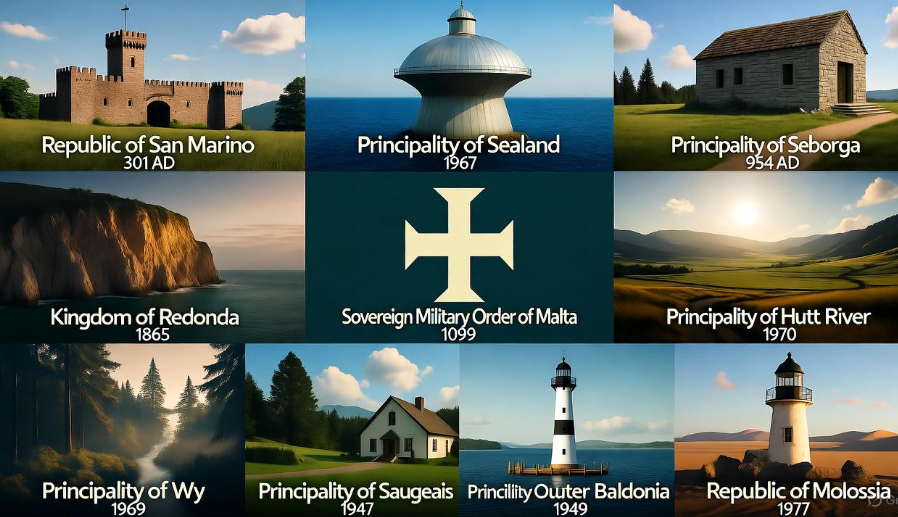

Ever imagined waking up one morning and deciding, “Hey, I’ll start my own country today”? Well, believe it or not, some people actually did that. Throughout history, there have been a bunch of tiny self-proclaimed countries — often started by dreamers, rebels, or just plain eccentric folks. They had flags, stamps, and even passports… but not much land.
These little “countries” are called micronations, and while most weren’t officially recognized, they sure have some fascinating stories. Let’s dive into eight of the weirdest ones that actually existed.
1. The Principality of Sealand 🏰
Now this one is legendary. Imagine an old, rusty sea fort in the middle of the ocean being turned into a kingdom — that’s Sealand.
Back in 1967, a man named Paddy Roy Bates took over an abandoned British fort called HM Fort Roughs, located about 7 miles off the coast of England. He declared it his own nation — “The Principality of Sealand.”
He gave himself the title of Prince Roy, created a flag, a national anthem, and even printed passports. Britain wasn’t amused, but since Sealand was outside British waters, they couldn’t do much.
| Fact | Details |
|---|---|
| Location | North Sea (off the coast of England) |
| Founded | 1967 |
| Founder | Paddy Roy Bates |
| Currency | Sealand Dollar |
| Motto | “E Mare Libertas” (From the Sea, Freedom) |
People still live there today — mostly a handful of caretakers — and they even have an official website. Talk about determination!
2. The Republic of Minerva 🏝️
In 1972, an American businessman named Michael Oliver decided he wanted to create a libertarian paradise — a country with no taxes, no government interference, and maximum freedom.
He found a small patch of reefs in the Pacific Ocean, near Tonga, and dumped sand on them to create artificial land. Then, he declared it the Republic of Minerva.
But here’s where things got funny — Tonga didn’t like the idea. The King of Tonga sent a small group of soldiers who raised the Tongan flag and ended Minerva before it ever really began.
| Fact | Details |
|---|---|
| Location | Pacific Ocean |
| Founded | 1972 |
| Founder | Michael Oliver |
| Reason | Libertarian utopia |
| Fate | Taken over by Tonga |
Minerva lasted barely a month, but it became a legend among freedom-seekers and libertarians.
3. The Kingdom of Redonda 👑
This one feels straight out of a novel — because it kind of is. The Kingdom of Redonda is a small, uninhabited island near Antigua in the Caribbean.
In the 1860s, a man named Matthew Dowdy Shiell claimed the island and declared himself King Matthew I. After him, his son — a writer named M.P. Shiel — inherited the “crown.”
Over time, this fictional kingdom became an inside joke among writers and poets. Many famous literary figures later claimed to be its “monarchs,” turning Redonda into a symbol of artistic freedom rather than a real nation.
| Fact | Details |
|---|---|
| Location | Caribbean Sea |
| Founded | Around 1865 |
| Founder | Matthew Dowdy Shiell |
| Type | Literary micronation |
| Population | 0 (completely uninhabited) |
It’s bizarre, poetic, and somehow charming — a country that lives mostly in imagination.
4. The Hutt River Principality 🇦🇺
This one actually lasted a surprisingly long time! In 1970, a farmer in Western Australia named Leonard Casley got into a dispute with the Australian government over wheat quotas.
He got so frustrated that he declared his farm an independent nation, calling it the Principality of Hutt River. He crowned himself “Prince Leonard” and issued his own currency and stamps.
For decades, Hutt River even had tourists visiting and a “royal family” running things. Eventually, though, it was dissolved in 2020 due to tax issues.
| Fact | Details |
|---|---|
| Location | Western Australia |
| Founded | 1970 |
| Founder | Leonard Casley |
| Area | About 75 sq km |
| Duration | 1970–2020 |
It might have ended, but for 50 years, this farmer ruled his own little kingdom — and that’s quite a record!
5. The Free Republic of Liberland 🇨🇿🇭🇷
Okay, now this one’s recent — and still exists today!
In 2015, a Czech man named Vít Jedlička claimed a small piece of unclaimed land between Croatia and Serbia, calling it Liberland. The land was technically a “no man’s land” left after a border dispute.
Jedlička declared it a free country for anyone who loves liberty, and thousands of people applied for citizenship online.
| Fact | Details |
|---|---|
| Location | Between Croatia and Serbia |
| Founded | 2015 |
| Area | 7 sq km |
| Motto | “To Live and Let Live” |
| Founder | Vít Jedlička |
Though neither Croatia nor Serbia recognizes it, Liberland still operates a website, has its own flag, constitution, and government-in-exile.
6. The Principality of Wy 🇦🇺🎨
Now, here’s a quirky one! The Principality of Wy started in 2004 in Australia — but not because of politics or land disputes. Nope, it began because of art.
An artist named Paul Delprat, who lived in Mosman (a suburb of Sydney), got into a long fight with the local council about driveway access to his property. Frustrated, he declared his home an independent nation — the Principality of Wy.
He even painted official portraits and created passports for fun.
| Fact | Details |
|---|---|
| Location | Sydney, Australia |
| Founded | 2004 |
| Founder | Paul Delprat |
| Reason | Dispute with local council |
| Type | Artistic micronation |
Wy still has an online presence, and the “Prince of Wy” continues promoting art and creativity. Sometimes rebellion can be… colorful! 🎨
7. The Conch Republic 🐚
In 1982, the U.S. Border Patrol set up a checkpoint between the Florida Keys and mainland Florida, causing long traffic jams. Locals were furious.
So, the mayor of Key West, Dennis Wardlow, came up with a hilarious protest. He declared Key West an independent nation called the Conch Republic, symbolically “seceded” from the U.S., and then “surrendered” a minute later — demanding foreign aid as a joke.
It was meant as a protest, but the idea stuck! Today, the Conch Republic is a big part of Key West’s identity, with festivals, flags, and even passports (for fun).
| Fact | Details |
|---|---|
| Location | Key West, Florida, USA |
| Founded | 1982 |
| Founder | Dennis Wardlow |
| Type | Protest Micronation |
| Motto | “We Seceded Where Others Failed” |
A country born from humor — and still going strong! 😄
8. The Kingdom of North Sudan 👑🌍
This one is wild — and surprisingly recent.
In 2014, an American man named Jeremiah Heaton traveled to a tiny strip of land between Egypt and Sudan known as Bir Tawil, which is one of the few places on Earth claimed by no country.
He planted a flag there and declared it the Kingdom of North Sudan, naming his daughter a princess.
His reason? She once told him she wanted to be a real princess — and he made it happen.
| Fact | Details |
|---|---|
| Location | Bir Tawil (between Egypt and Sudan) |
| Founded | 2014 |
| Founder | Jeremiah Heaton |
| Reason | For his daughter |
| Population | 0 (uninhabited desert) |
Although the UN didn’t recognize it, the story went viral, showing how dreams (and a bit of adventure) can turn into royal tales.
A Quick Comparison Table 🗺️
| Micronation | Year Founded | Founder | Main Reason | Current Status |
|---|---|---|---|---|
| Sealand | 1967 | Paddy Roy Bates | Freedom / Independence | Still exists |
| Minerva | 1972 | Michael Oliver | Libertarian freedom | Dissolved |
| Redonda | 1865 | M. D. Shiell | Literary / Symbolic | Still symbolic |
| Hutt River | 1970 | Leonard Casley | Tax dispute | Dissolved (2020) |
| Liberland | 2015 | Vít Jedlička | Liberty movement | Active online |
| Wy | 2004 | Paul Delprat | Art protest | Exists symbolically |
| Conch Republic | 1982 | Dennis Wardlow | Protest | Still celebrated |
| North Sudan | 2014 | Jeremiah Heaton | Gift for daughter | Unrecognized |
Why People Start Micronations 🤔
There’s something oddly fascinating about people creating their own countries. Some do it for freedom, some for protest, and some just for fun. These micronations might be small, but they represent big ideas — creativity, independence, and sometimes just plain human curiosity.
At the heart of every micronation is a story of someone saying, “I want to do things my way.” And honestly, that’s kind of inspiring, isn’t it?
FAQs About Micronations 🌍
Q1. What exactly is a micronation?
A micronation is a small, self-declared “country” that claims independence but isn’t officially recognized by other nations or the United Nations.
Q2. Can anyone start a micronation?
Technically, yes — but recognition is the hard part. Many people declare micronations on private property or unclaimed land, though it rarely leads to actual sovereignty.
Q3. Are there still micronations today?
Yes! Sealand, Liberland, and the Conch Republic are still active today, among many others around the world.
Q4. Do micronations have their own money and passports?
Some do — mostly symbolic ones. Sealand, for example, has its own coins and passports, though they’re not legally valid.
Q5. What’s the weirdest micronation ever?
That’s tough! The Kingdom of North Sudan, created just to make a little girl a princess, might take the crown for pure heart and weirdness combined. 👑
Final Thoughts 💭
Micronations show how imagination can challenge reality. They’re tiny in size but huge in spirit — proof that human creativity knows no borders.
From sea forts to desert kingdoms, these mini-countries might not have armies or recognition, but they do have something special: the courage to dream big in a very small space. 🌏✨