
Have you ever imagined a country so tiny that you could walk across it in minutes? Or a place that has its own king, flag, and currency—yet isn’t officially recognized by the United Nations? Welcome to the fascinating world of micronations.
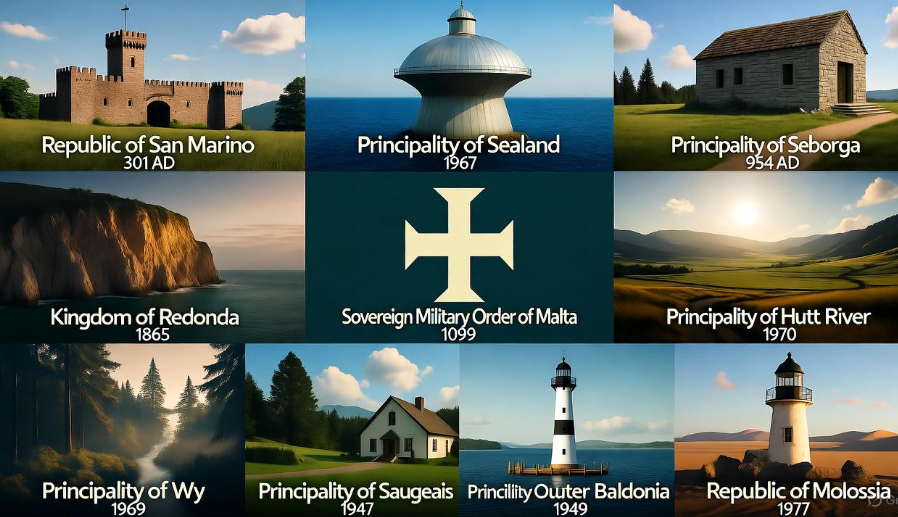
These are small, self-declared “countries” that claim independence but aren’t officially recognized as real nations. Some were born from jokes, others from protest or art projects. Yet, surprisingly, a few have survived for decades—or even centuries! Let’s explore the 10 oldest micronations that still exist today and discover their amazing stories.
1. The Principality of Sealand 🇬🇧
It all started back in 1967, when a former British Army major named Paddy Roy Bates occupied an abandoned World War II sea fort called HM Fort Roughs, located just outside the UK’s territorial waters.
He declared it as an independent country—The Principality of Sealand—and even named himself Prince Roy. Sealand has its own flag, currency (the Sealand Dollar), national anthem, and even passports (though these are no longer valid).
Despite its tiny size (just 0.004 square kilometers), Sealand has survived armed invasions, legal battles, and storms. The British government once tried to claim it but failed in court, which only strengthened Sealand’s independence claims.
Today, Sealand still exists under the Bates family’s rule and even issues digital citizenship and titles of nobility to raise funds.
| Feature | Details |
|---|---|
| Founded | 1967 |
| Founder | Paddy Roy Bates |
| Location | North Sea, off the coast of England |
| Area | 0.004 sq km |
| Currency | Sealand Dollar |
2. The Republic of San Marino 🇸🇲
Long before most modern countries existed, San Marino was already thriving. Founded in 301 AD, it’s often called the oldest surviving sovereign state in the world.
San Marino sits on a mountain surrounded by Italy and covers just 61 square kilometers. According to legend, it was founded by Saint Marinus, a Christian stonemason who fled persecution.
What makes San Marino fascinating is how it maintained independence through countless European wars, invasions, and empires. Napoleon respected its neutrality, and so did both sides during World War II.
Even today, San Marino has its own constitution (from 1600), two heads of state (called Captains Regent), and a charming medieval capital filled with towers and cobblestone streets.
| Feature | Details |
|---|---|
| Founded | 301 AD |
| Founder | Saint Marinus |
| Location | Enclosed by Italy |
| Area | 61 sq km |
| Government | Parliamentary Republic |
3. The Principality of Liechtenstein 🇱🇮
Nestled between Switzerland and Austria, Liechtenstein was founded in 1719 by the Holy Roman Emperor, who united two small territories—Vaduz and Schellenberg—into a principality for the Liechtenstein family.
It’s one of the world’s oldest and wealthiest microstates, with a population of around 39,000 people. Liechtenstein is famous for its breathtaking Alps, strong economy, and zero national debt.
Though small, it’s fully recognized by the United Nations and has its own prince, government, and banks (which are some of the most secure in the world).
| Feature | Details |
|---|---|
| Founded | 1719 |
| Founder | Liechtenstein Dynasty |
| Location | Central Europe |
| Area | 160 sq km |
| Government | Constitutional Monarchy |
4. The Most Serene Republic of San Marino 🇸🇲
Wait—San Marino again? Yes! It deserves a double mention because it has never been absorbed or conquered, which is rare in European history. Even Napoleon once said, “San Marino is a model republic.”
It’s tiny but powerful in spirit, with one of the highest GDPs per capita in Europe. Tourism, banking, and stamp collection make up much of its income.
Fun fact: San Marino sent Abraham Lincoln an honorary citizenship certificate, and he called it “one of the most honored republics in history.”
5. The Sovereign Military Order of Malta 🇲🇹
This isn’t just a micronation—it’s also one of the world’s oldest religious and chivalric orders. The Order of Malta began around 1048 AD in Jerusalem, offering medical aid to pilgrims during the Crusades.
Although it no longer controls territory like a traditional country, the Order is recognized as a sovereign entity with diplomatic relations with over 100 countries. It issues its own passports, coins, and stamps and operates hospitals and humanitarian missions worldwide.
It even has permanent observer status at the United Nations. Its headquarters are located in Rome but considered extraterritorial, meaning it’s legally outside Italian control.
| Feature | Details |
|---|---|
| Founded | 1048 AD |
| Founder | Knights Hospitaller |
| Location | Rome (headquarters) |
| Area | 0.012 sq km |
| Type | Sovereign Order |
6. The Principality of Seborga 🇮🇹
This one’s a fun story! The Principality of Seborga, located in northern Italy, claims to have been a sovereign state since 954 AD—long before Italy even existed.
For centuries, Seborga was under the protection of monks who sold it to the King of Sardinia in 1729. But… the sale was never officially registered, which gave locals a strange legal loophole to claim independence centuries later.
In 1963, a local flower farmer named Giorgio Carbone revived the claim and declared himself Prince Giorgio I.
Even today, Seborga has its own royal family, stamps, passports, and even a local currency called the Luigino.
| Feature | Details |
|---|---|
| Founded | 954 AD |
| Founder | Benedictine Monks |
| Location | Italy (near French border) |
| Area | 14 sq km |
| Currency | Luigino |
7. The Principality of Hutt River 🇦🇺
Deep in the Australian Outback, Prince Leonard (real name: Leonard Casley) declared his wheat farm independent in 1970 after a dispute with the Australian government over grain quotas.
He named it the Principality of Hutt River and issued his own stamps, coins, and passports. For decades, it attracted curious travelers and even hosted international ambassadors.
Although Australia never recognized it, Hutt River operated independently until 2020, when it was dissolved due to financial pressures. Still, its legacy remains one of the most iconic examples of peaceful “rebellious” micronations.
| Feature | Details |
|---|---|
| Founded | 1970 |
| Founder | Leonard Casley |
| Location | Western Australia |
| Area | 75 sq km |
| Currency | Hutt River Dollar |
8. The Republic of Molossia 🇺🇸
If you’ve ever wanted to visit a country inside another country, head to Dayton, Nevada, USA. There, you’ll find the Republic of Molossia, founded in 1977 by Kevin Baugh and a friend as a childhood project—and it still exists today!
Molossia claims independence from the U.S. and even has a “war” ongoing with East Germany (yes, even though East Germany no longer exists). 😂
They have their own currency called the Valora, made from poker chips, a postal system, and strict customs rules. Visitors need a passport stamp to enter!
| Feature | Details |
|---|---|
| Founded | 1977 |
| Founder | Kevin Baugh |
| Location | Nevada, USA |
| Area | 0.005 sq km |
| Currency | Valora |
9. The Kingdom of Tavolara 🇮🇹
Once upon a time, a fisherman became a king. In 1836, an Italian fisherman named Giuseppe Bertoleoni claimed a small island off Sardinia called Tavolara and declared himself its ruler.
The local legend says that King Charles Albert of Sardinia visited the island, recognized Bertoleoni’s claim, and declared, “You are the King of Tavolara.”
Though small (just 5 square kilometers), Tavolara has a royal family that still lives there, running a restaurant and protecting the island’s beautiful marine park.
| Feature | Details |
|---|---|
| Founded | 1836 |
| Founder | Giuseppe Bertoleoni |
| Location | Off Sardinia, Italy |
| Area | 5 sq km |
| Type | Constitutional Monarchy |
10. The Republic of Minerva 🌊
In 1972, American businessman Michael Oliver tried to create a libertarian paradise on a coral reef between Tonga and Fiji. He dumped sand to build up the land and declared it the Republic of Minerva, complete with its own flag and currency.
Unfortunately for Oliver, the nearby Kingdom of Tonga quickly claimed the reef as its territory and ended the dream. Still, Minerva remains one of the most daring experiments in modern nation-building.
| Feature | Details |
|---|---|
| Founded | 1972 |
| Founder | Michael Oliver |
| Location | South Pacific Ocean |
| Area | Reef-based |
| Currency | Minerva Dollar |
Why Micronations Exist 🌐
Micronations exist for many reasons—some political, some personal, and others just for fun. People create them to protest government control, experiment with new political systems, or simply express creativity.
| Reason | Example |
|---|---|
| Political protest | Hutt River (against Australia’s tax laws) |
| Artistic expression | Sealand (freedom and independence) |
| Historical claim | Seborga (ancient rights) |
| Tourism & fun | Molossia (humorous independence) |
Even though none of them are officially recognized by the UN, many have stood the test of time and continue to inspire others to question what it really means to be a nation.
Fun Facts You Didn’t Know 😄
-
Sealand once fought off armed mercenaries in what’s known as the “Sealand War.”
-
San Marino has no national debt—it’s completely debt-free!
-
Liechtenstein rents out its entire country for corporate events!
-
Molossia’s “war” with East Germany officially continues because no peace treaty was signed.
-
Seborga holds annual parades where the prince appears in full royal costume.
Are Micronations Legal? ⚖️
Yes and no. Most micronations exist in a legal gray area. They don’t break laws (as long as they pay taxes and obey local authorities), but they’re not recognized as sovereign states either.
International law only recognizes a nation if it meets four conditions known as the Montevideo Convention (1933):
-
A permanent population
-
A defined territory
-
A government
-
The ability to enter into relations with other states
Micronations usually fail the last condition, but that doesn’t stop them from trying!
The Future of Micronations 🚀
With digital technology, new forms of “online micronations” are emerging. Some exist entirely in the metaverse, with their own virtual land, currencies, and citizens. Sealand, for example, has gone digital by selling online titles and NFTs.
Who knows? In the future, your neighbor might become a “Prince of Pixelonia” or “Queen of Blockchainia.”
The idea of creating your own country might sound silly, but it shows how creative and independent humans can be—even in a world dominated by giant nations.
FAQs 🤔
Q1: What is the difference between a micronation and a microstate?
A microstate is a real recognized country (like Monaco or Liechtenstein), while a micronation is self-declared and not officially recognized by the UN.
Q2: Can I start my own micronation?
Technically yes, but you’ll need land (or a platform like Sealand) and a clear purpose. Just don’t expect the world to recognize it officially.
Q3: Do any micronations have citizens?
Yes! Many have small communities or online citizens. Sealand and Molossia both offer honorary citizenship programs.
Q4: Are micronations safe to visit?
Most are harmless tourist attractions. However, always check local laws before visiting, as some are located on private land or restricted areas.
Q5: What is the smallest micronation in the world?
Sealand is often considered the smallest, with only about 0.004 square kilometers of land!
Final Thoughts 🌏
Micronations may be small, but their stories are huge. They remind us that independence isn’t just about size or power—it’s about imagination, courage, and a desire for freedom.
From the medieval hills of San Marino to the sea forts of Sealand, these tiny nations have proven one thing over centuries: even the smallest place can hold the biggest dreams. 💫